Unlocking profitable book sales on Amazon starts with mastering keyword research, the cornerstone of any successful KDP publishing strategy. In this comprehensive guide, you’ll discover the proven methods to validate Amazon keyword ideas, filter out unprofitable options, and construct a winning keyword strategy based on real demand. Whether you’re just starting out or looking to scale your publishing business, learn how to harness the power of data-driven keyword validation for smarter book launches, better rankings, and sustainable royalties. Ready to transform your keyword approach? Let’s dive into actionable steps that elevate your Amazon KDP results.
Key Highlights
- Validating Amazon keywords with data is essential for profitable publishing and avoiding wasted effort on unproven ideas.
- BookBeam empowers KDP publishers to identify high-potential keywords and profitable niches through robust analytics and competitive insights.
- Successful keyword research balances search volume, competition, and relevancy, ensuring higher ranking and sustained book sales.
- Backend keywords and optimized metadata significantly boost Amazon product visibility beyond just the public-facing listing details.
- Continuous keyword monitoring and regular audits are crucial for adapting to Amazon’s evolving marketplace and sustaining long-term publishing growth.
Understanding the Fundamentals of Amazon Keyword Validation
Profitable publishing on Amazon hinges on mastering the fundamentals of keyword validation. For aspiring Amazon KDP publishers, validating amazon keyword ideas isn’t just a technical step, it’s the backbone of your entire strategy. Learning how the Amazon algorithm interacts with keyword data, how to read search volume, and how to distinguish impactful search terms from generic keywords is crucial. A robust keyword research foundation means a stronger listing, higher sales, and smarter publishing decisions. If you want to stop guessing and start making data-driven choices, it starts by understanding why keyword data is the linchpin for successful Amazon publishing, and how to validate every product idea before you publish.
Why Keyword Data Drives Profitable Publishing Decisions on Amazon
Many Amazon publishers leap headfirst into product listings or book launches, assuming that creativity alone will carry their brand to the bestseller ranks. But the truth is, the Amazon algorithm is agnostic to your passion, it responds to data. Validating your amazon keyword ideas is the essential task that separates profitable publishing from wasted potential. Every step you take, from brainstorming new product ideas to optimizing listing details, flows back to keyword data and its role in the modern Amazon ecosystem.
The heart of Amazon’s recommendation engine and search algorithm is built on keywords and search terms. Think about what shoppers type into the search bar, they don’t know your brand yet; they’re armed with needs and specific terms. Ignoring this reality is one of the most common mistakes Amazon sellers and publishers make. Instead, start by anchoring your publishing strategy in targeted keyword research. A fundamental principle is that amazon keyword data reveals real shopper intent and demand. By tapping into this information, you’re not just crossing items off a checklist, you’re validating with Amazon’s data, ensuring your decisions are grounded in verified market signals.
When you validate an amazon keyword, you assess real-time demand and competition. That means digging beyond basic search volume or trend data. Using tools like BookBeam or even referring to sources like Jungle Scout, you can get granular with metrics, evaluating the competitive score for specific keywords, the ranking strength of top competitor product listings, and the actual sales trajectory for relevant terms. What’s powerful about validation is that it acts as a filter, keeping you focused only on keywords and products with proven traction on Amazon.
Consider how validating each keyword shapes your publishing outcomes. If you choose keywords simply because they sound relevant, your book or product can get buried in the vast sea of Amazon listings. Instead, when you back up every decision with hard data, search volume, keyword competition, and related keyword trends, you’re relying on evidence, not assumptions. For instance, targeting branded keywords, seasonal search terms, or trending product niches demands a complete understanding of their current and historic metrics. Mistaking a spike in search traffic for sustainable demand can lead to overstock, lost sales, or wasted ad spend.
Amazon’s algorithm rewards publishers who consistently provide value and relevancy. This directly ties to keyword validation. The fundamentals you establish by validating your keywords ensure your listings connect with what real Amazon shoppers are searching for, not merely what you wish they were searching. As your keyword strategy matures, data from validated terms fuels every aspect of your publishing roadmap, from content and metadata optimization to backend keywords that extend your organic reach.
But validation isn’t a one-time task. The Amazon market shifts quickly. Trends change, competitors come and go, and new products alter shopper behavior. The only way to maintain a profitable, scalable Amazon publishing business is by committing to continuous keyword research and validation. Frequent monitoring lets you adapt your product listing and publishing strategies as new data emerges. This approach transforms your decision-making, from launching only what’s most likely to succeed to adjusting listings based on live keyword trends.
Integrating keyword data into your publishing fundamentals lets you innovate confidently. Instead of chasing scattershot opportunities, you become strategic. You know exactly which keywords indicate a real demand, the competitive barriers to entry, and the best path to sustainable sales. By viewing every Amazon keyword as a door to potential profit, you can focus your efforts where real market opportunity exists.
To amplify your competitive edge, use keyword validation not just to optimize a single listing or book, but to plan your entire publishing roadmap. This clarity gives your brand staying power, enabling you to track, adjust, and grow your presence on Amazon with every new insight. Whether you’re using BookBeam’s comprehensive keyword analytics, leveraging third-party keyword research tools, or combining both, remember: effective keyword validation is the ultimate foundation for profitable Amazon publishing. If you want consistent sales and a resilient Amazon brand, make every publishing decision with data, and keep keyword validation at the center of your strategy.
How Amazon Keyword Research Transforms Your KDP Strategy
Empowering your Amazon KDP journey begins with sound keyword research. When you treat Amazon keyword research as a data-driven discipline, not just a creative afterthought, you turn every book idea, product listing, and even backend keyword into a calculated market move. Effective keyword research doesn’t simply enhance your visibility; it transforms your entire KDP strategy. From zeroing in on high-intent search terms to refining your approach with search volume data, understanding fundamentals leads to confident, profitable publishing decisions. Let’s look at exactly how targeted keyword strategy and Amazon’s search algorithm can unlock sustainable growth and outpace the competition.
Actionable Steps to Conduct Amazon Keyword Research Efficiently
Transforming your results on Amazon starts by revolutionizing how you conduct keyword research, the engine that drives every successful KDP and product listing. Forget guesswork; the real magic lies in using data, strategy, and repeatable steps to uncover, evaluate, and implement keywords that align with actual shopper demand on Amazon.
First, start by establishing clear fundamentals. Effective amazon keyword research is about matching your book or product to the exact search terms that Amazon shoppers are already using. If your approach isn’t rooted in what real buyers are typing into the amazon search bar, you’re fighting an uphill battle. Think of keyword research as your competitive scout, it illuminates profitable niches, untapped audiences, and reveals the sales potential before you even commit to a book or product idea.
Begin by brainstorming an initial keyword list related to your niche or subject. Dive deep into customer language: scan Amazon product listings, read book reviews, and study bestseller categories. Extract the words and phrases that consistently appear, these are clues about high-traffic search terms and potential long-tail keywords. Don’t limit yourself to obvious choices; scout for unique terms by looking at both successful competitors and underserved areas.
Once your initial keyword list is built, validate each keyword using real data. This is where most KDP publishers falter, don’t rely on assumptions or keyword intuition alone. Use reliable tools like BookBeam or Jungle Scout, which are designed specifically for Amazon keyword research and analytics. With these platforms, you can instantly assess search volume, track historical trends, and estimate how many shoppers are searching for your terms compared to others. High search volume indicates potential, but you need to dig further, competition matters just as much.
Competitive score is a direct indicator of how challenging it’ll be to rank for specific search terms. Tools like BookBeam analyze not just the search volume, but also the number of competing product listings, listing quality, and how entrenched top sellers are for those keywords. Aim for a balance between opportunity and competition, if a keyword shows solid demand but isn’t completely saturated with high-performing listings, that’s your sweet spot. Use this strategy to unearth both main and long-tail keywords that offer a realistic path to visibility and sales.
It’s critical to choose a mix of keywords: include seven keyword boxes (backend keywords Amazon offers to every publisher), your core keyword targets for the title and subtitle, plus additional branded or niche-specific keywords. Remember, backend keywords aren’t visible to shoppers but are read by Amazon’s algorithm, they extend your organic reach when used wisely.
At every step, let data guide your decisions. For instance, don’t commit to a keyword simply because it fits your product; cross-verify with search volume and competitive score. A keyword with low search volume but great competition might not justify the effort. Conversely, a high-volume term with little relevant competition could signal a profitable, underserved niche.
Understand how Amazon’s algorithm weighs keywords within listings and metadata. The strength of your listing comes from how well you match high-intent search terms, appropriate product categories, and relevant long-tail keywords. Shoppers often search with specific problems or outcomes in mind, so match your product listing to those needs exactly. Integrating core keywords naturally into your product description, bullet points, and especially the title, helps both Amazon’s algorithm and real shoppers quickly see relevance, increasing your chances of ranking and conversion.
Tracking is the next critical step. After publishing, continually monitor your keyword rankings, listing performance, and competitor movements. The Amazon marketplace shifts rapidly, so keyword trends, search volume, and even the “right” product listings for your niche may change in weeks, not months. Use tools like BookBeam to scout for shifts in search demand, competitive score changes, or new entrants into your space. Adjust your backend keywords, listing copy, and even product pricing or cover design if necessary.
Don’t underestimate the fundamentals: data-driven keyword validation is an ongoing process. Run keyword audits regularly to uncover declining keywords, rising opportunities, or potential gaps in your listings. Take action, batch new keyword research efforts ahead of seasonal changes, major holidays, or market trends.
Remember, success isn’t about stuffing as many keywords as possible into your listing; it’s about writing for the algorithm while speaking to your reader. Strategic keyword placement and ongoing validation turn every listing into an asset that grows more valuable over time.
The goal of this disciplined approach is clear: to make every publishing decision, from new product launches to listing optimization, rooted in verified keyword research and Amazon marketplace data. By doing so, you avoid wasted efforts, tap into profitable niches, and ensure that your brand is seen by shoppers most likely to buy.
Ready to level up your KDP results? Start applying these fundamentals with every book concept or product idea and let BookBeam’s suite of keyword analytics and competitor-tracking features guide you toward smarter, data-backed publishing strategies. Validate, prioritize, and implement keywords not just as a checklist, but as a powerful driver of sustained growth and profitability on Amazon.
Uncovering Profitable Niches With Amazon Search and Analytics Tools
Discovering where the real profit lies on Amazon isn’t about luck, it’s about leveraging data-backed strategies and mastering powerful analytics tools. The explosion of Amazon search volume and the ever-evolving algorithm have created an environment where only publishers who understand true keyword fundamentals access untapped, lucrative niches. Tools like BookBeam, Jungle Scout, and advanced analytics platforms help you move past guesswork to a precise understanding of search terms, competitive score, long-tail keywords, and overall market opportunity. Pinpointing the right product listings and gathering actionable data transforms your KDP publishing journey from trial-and-error into steady, sustainable growth.
Leveraging BookBeam to Pinpoint High-Potential Amazon Keyword Opportunities
When it comes to finding truly profitable niches on Amazon, the difference between average and high-performing publishers often boils down to how effectively they use analytics and search tools. BookBeam, designed specifically for Amazon KDP self publishers, allows you to leave that old “throw spaghetti at the wall” approach behind. Instead, you can systematically use search, data, and robust analytics to pinpoint amazon keyword opportunities that consistently drive sales and organic growth for your brand, and keep you ahead of the competition.
Let’s get clear on the fundamentals: On Amazon, your niche isn’t just the topic you write about; it’s the intersection of proven search demand, competition you can actually beat, and keywords the algorithm already favors. BookBeam’s analytics engine is laser-focused on combining these fundamentals, empowering you to scout profitable opportunities in ways generic market research tools just can’t. With Amazon’s massive search volume and ever-shifting shopper behavior, relying on guesswork or a “feels right” method will sabotage your publishing momentum. BookBeam removes that uncertainty by making real demand visible.
Begin by using BookBeam’s keyword research module to enter seed search terms related to your niche. Suppose you’re considering books on “plant-based meal prep” or “budget travel journals”, instead of simply speculating which long-tail keywords shoppers use, BookBeam surfaces search volume, competitive score, and related backend keywords so you see immediately which products are rising in the algorithm and which terms are ripe for ranking. It doesn’t stop at main keywords either; BookBeam drills down into tail keywords and untapped search clusters many Amazon sellers and publishers miss.
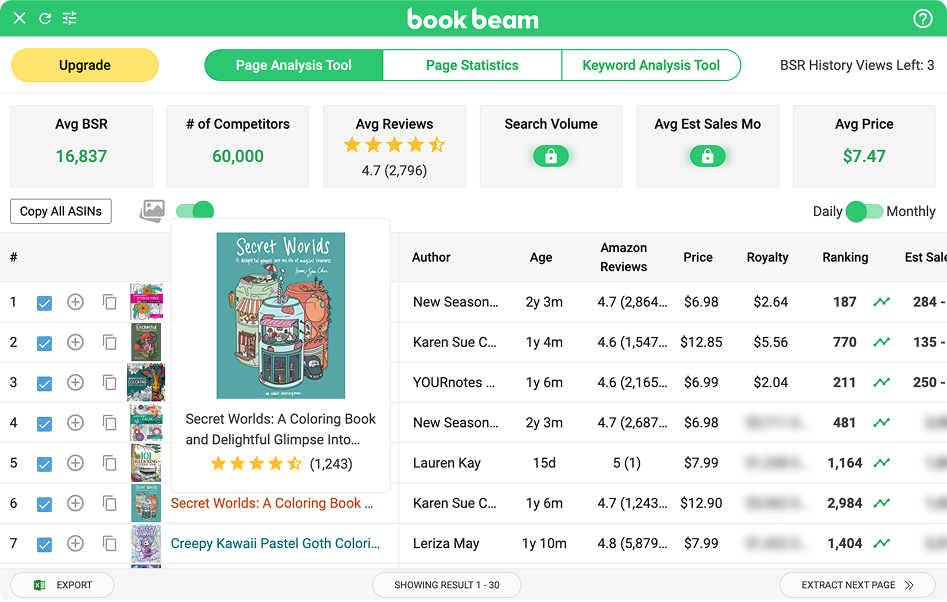
One powerful advantage of analytics tools is their ability to reveal the factors driving a product’s success, and BookBeam delivers. It will chart not just the overt search volume for a keyword, but also the performance of top product listings targeting the same terms. This means you’re not wasting energy chasing hyper-competitive, saturated search spaces where entrenched brands have already claimed territory. Instead, you zero in on true opportunities, niches with high amazon search interest and manageable competition. Through BookBeam’s advanced data, you view the competitive score alongside estimated sales, giving you full clarity before investing in a listing or product.
Using the tool’s analysis features, you can sort, filter, and benchmark keywords by their historic search volume, how often they appear in winning product listings, and their current trend trajectory on Amazon. This strategic layer is critical for publishers who want to back every decision with verified data: for example, identifying seven keyword boxes (Amazon’s backend keyword fields), curating the most promising combinations of branded and niche terms, and then modeling different listing strategies before pushing your book live. Amazon’s algorithm prioritizes both keyword relevancy and completeness in a listing; with BookBeam, those requirements are handled before launch, setting your product up for maximum organic exposure.
One of the most overlooked fundamentals in keyword research is competitive intelligence, knowing which amazon sellers are already dominant in a “profitable” niche, how their listings are structured, and where the real gaps lie. BookBeam not only identifies competitors but breaks down their keyword usage, listing strategies, and even backend keyword patterns. This lets you spot opportunities others ignore, like trending tail keywords with increasing search demand but minimal high-quality competition. Cutting through noise is crucial; fancy covers or clever titles won’t sell if you’re competing against established listings with bulletproof keyword strategy.
Beyond surface-level keyword research, BookBeam empowers you to build a brand and not just chase the next product. By continuously monitoring analytics and adjusting your listings as search trends change, you gain compound advantage with every product you launch. Use BookBeam’s tracking tools to see how changes in backend keywords, product titles, or bullet points impact your listing performance over time, then adapt future strategy based on real sales and ranking data. That’s how you create a publishing portfolio that delivers profits quarter after quarter.
But what about long-tail keywords and the elusive “hidden” markets on Amazon? BookBeam shines here too. Long-tail keywords often have lower individual search volume but collectively support steady, qualified traffic, meaning higher conversion rates and greater listing longevity. The analytics dashboard exposes sub-niche opportunities, such as “single parent meal planning on a budget” or “mindfulness coloring books for teens,” terms that would take days or weeks to uncover manually. When you see the keyword fundamentals side-by-side with search volume, trend graphs, and competitive scores, you can make bold, evidence-based moves into new niches.
Your product listing strategy is only as strong as the data it’s built on. With BookBeam, you’re guided by accurate amazon search analytics, competitive intelligence, and real historical data, not vague hunches or trend-chasing. Use these fundamentals to guide every publishing decision: from determining the right amazon keyword mix for the front and backend, to structuring your metadata for optimal search relevancy, to choosing which product or book ideas deserve your investment and creative energy.
Here’s your action step: Next time you’re evaluating a book or product idea, don’t rely on surface-level intuition or copy what top sellers are doing. Fire up BookBeam, run your list of search terms through its tools, analyze competitive score, and identify the precise niches where search volume and algorithmic opportunities align. This is how you break through to truly profitable publishing and build a resilient Amazon brand, not just for the next trend, but for long-term market leadership.
Ready to level up your publishing income? BookBeam is your all-in-one competitive scout, analytics workhorse, and strategy partner, so you can pinpoint, validate, and win the most profitable Amazon keyword and niche opportunities, every single time.
Evaluating Search Volume and Competition for Effective Keyword Research
Getting your Amazon publishing strategy right means moving far beyond intuition and diving deep into real data. Evaluating search volume and competition is a core skill that separates thriving publishers from those who struggle to gain traction. Smart keyword research puts your efforts under a microscope, highlighting not just what shoppers are searching for, but also where you stand against other product listings and brands. By carefully analyzing critical metrics like search volume, keyword competition, and overall demand, you set the stage for informed, confident product launches on Amazon. Mastering these fundamentals ensures your book or product isn’t buried by competitors, but instead stands out, right where buyers are actively looking.
Practical Tips to Assess Amazon Keyword Demand and Standing Out
To truly succeed as a self-publisher on Amazon, you can’t afford to trust gut feelings or guess which keywords might work. Instead, you need to put every keyword idea under the microscope using proven research strategies and data-rich analytics tools. Assessing demand begins with understanding the search volume behind each amazon keyword you’re considering. High search volume means real shoppers are typing these search terms into Amazon, signaling concrete buyer interest. But that’s only part of the equation: competition determines just how easy or hard it will be to break into those search results.
Start by assembling a list of possible keywords, drawing on book topics, product features, and browsing social proof from reviews and discussions. Focus especially on long-tail keywords; these are detailed search phrases often used by serious buyers ready to take action. While “diet cookbook” may have enormous search traffic, “plant-based meal prep for athletes” or “quick gluten-free snacks for beginners” offer more focused demand and generally less competition. Those kinds of tail keywords, gathered through diligent keyword research with analytics platforms like BookBeam or Jungle Scout, provide the edge you need.
Once you’ve compiled your keyword shortlist, it’s time to dig into search volume data. BookBeam pulls reliable search volume stats for each amazon keyword, showing you which terms have seasonal surges, steady year-round demand, or are rapidly trending upwards. Always analyze data in context, not every spike in search volume equates to lasting niche demand. Compare those numbers to your publishing calendar and sales cycle to align product launches with peak search terms.
Competition analysis is equally critical. The best keywords balance healthy demand with realistic opportunities for your listing to rank. BookBeam and Jungle Scout both offer competition or competitive score metrics for each keyword. This competitive score reveals how many other products and listings are targeting your keywords, how entrenched the leading brands are, and how closely the top listings match searcher intent. If the competitive score is extremely high, breaking through will require significant resources, better listings, ad spend, and possibly a stronger brand presence. If it’s lower, especially for long-tail keywords, you have a prime opportunity to get in front of buyers without being steamrolled by big brands.
Assessing keyword demand on Amazon isn’t just about looking at one or two numbers. It’s about triangulating several data points: search volume, competitive score, the quality of current top product listings, and sales velocity for similar titles or products. Dive into these metrics using BookBeam’s analytics dashboard. For each amazon keyword, look at monthly search volume, the historical trend line (is demand growing, stable, or dropping?), and the quality of product listings in the top results.
Don’t neglect backend keywords, a crucial area often overlooked. Amazon’s algorithm reads backend keywords to surface your product to more shoppers, but these don’t show up in the public-facing listing. Use all seven keyword boxes Amazon gives you, populating each with highly relevant search terms, tail keywords, and alternate spellings or synonyms. Backend keywords broaden your organic reach, often plugging your product into low-competition niches where buyers are searching but few strong listings are competing.
Now, let’s add a practical tip that dramatically boosts your efficiency: create a validation checklist for each keyword. This should include (1) target search volume range (e.g., at least 500 monthly searches for tail keywords), (2) competitive score threshold (e.g., avoid anything in the top 10% for competition unless you have a standout product), (3) counts of established brand listings in the top 10 results, (4) diversity of product types in those listings, and (5) potential gaps or patterns among current top sellers. BookBeam’s analytics exports help you build and refine this checklist quickly, so your keyword research isn’t a scattershot effort, but a disciplined, data-driven process.
Evaluating demand is also about opportunity cost: don’t sink effort into keywords that look promising but are owned by entrenched brands, especially if the listing quality and number of reviews are out of reach for a new product. Instead, leverage analytics data to pinpoint keywords with emerging demand, where the top listings show weaker covers, less compelling copy, or low organic sales. These are windows of opportunity for fast-moving KDP publishers to stake a claim.
Don’t forget to continually track your results after launch. Amazon’s algorithm is dynamic; search volume and competition change as trends shift or as other publishers refine their strategies. Set up weekly or monthly check-ins with your analytics tool, monitoring shifts in your chosen keywords’ metrics. If a keyword’s search volume drops or if the competitive score spikes unexpectedly, rerun your keyword research and adjust backend keywords or product listings accordingly.
For every new product or book, let your keyword validation process build off the fundamentals detailed here and in previous discussions, rooting every decision in verified Amazon data, and always keeping your brand’s unique value front and center. When you rely on analytics, not assumptions, your listings break through the noise and connect with real shoppers.
Ready to make your keyword research efficient and actionable? Harness BookBeam’s suite of keyword analytics, competitive intelligence, and real-time data tracking. Spot gaps in the market, validate ideas with confidence, and ensure every product listing leverages the full power of Amazon keyword strategy. Don’t just publish, publish smarter, validate every move, and build a brand that grows with every data-backed decision.
Integrating Backend Keywords for Maximum Amazon Visibility
Maximizing discoverability on Amazon means going beyond front-facing keywords. Serious Amazon KDP publishers know that backend keywords are a secret lever for visibility, allowing your product listings to surface for many relevant search terms without cluttering public copy. Everything from metadata to the integration of niche and tail keywords in Amazon’s backend can be optimized for reach, demand, and algorithmic relevance. Effective backend keyword strategy relies on data, not guesswork, using real analytics from sources like BookBeam or Jungle Scout, and understanding the interplay between search volume, competition, and the ever-evolving Amazon algorithm. Let’s explore how optimizing metadata and integrating the right backend keywords can powerfully extend your Amazon reach.
Optimizing Metadata for Enhanced Reach and Relevance on Amazon
If you want your Amazon product, especially a book, to win in the world’s most competitive online marketplace, you must master the art of optimizing metadata. Metadata forms the skeletal structure of every Amazon KDP listing, think title, subtitle, product description, and those all-important backend keyword fields. But optimization isn’t about dumping as many keywords as you can find; it’s a disciplined process rooted in fundamentals, analytics, and a deep understanding of Amazon’s algorithm and search mechanics.
Start by reevaluating how you approach keyword research. Too many publishers chase only the most obvious keywords lifted from bestseller lists, but the real opportunity for brand growth lies in balancing main Amazon keywords with tail keywords and niche search terms revealed by data-driven tools like BookBeam or Jungle Scout. Generating your initial keyword set should focus on both what shoppers are searching for (search volume) and existing competition (competitive score). Don’t neglect analytics here: scout not just for high numbers, but for meaningful patterns, like trending search phrases or underutilized tail keywords with clear purchase intent.
When you’ve identified your potential keywords, the next step is integration. Here’s where many Amazon sellers misjudge the algorithm. Your main keyword belongs in the title, naturally woven into the narrative, while strong supporting keywords can be flowed into the subtitle, bullet points, and product description, but what about all those highly-relevant terms that didn’t make the public copy? That’s where backend keywords shine.
Amazon gives you up to seven keyword boxes on the backend. This real estate is gold. The best strategy is to populate these fields with an efficient blend of search terms that aren’t already visible in your listing, focusing on alternate spellings, synonyms, long-tail variations, and overlooked branded terms. Back your decisions with hard data: only use keywords with substantiated search volume, a reasonable competitive score, and clear relevance to your niche. If analytics from BookBeam reveal a tail keyword that matches your listing but isn’t dominated by entrenched brands, prioritize it.
But simply compiling backend keywords isn’t enough. Integration is about synergy, each backend keyword should reinforce your listing’s focus and relevance in the eyes of Amazon’s algorithm. Avoid using duplicated terms from your public copy, and skip grammatical connectors or filler. Remember, the algorithm reads these fields as pure signals; it doesn’t care about sentence structure.
Your backend keyword boxes are also a top place to include niche market language. Look for the language real shoppers use in reviews, Q&A sections, and even competitor product listings. If you’re selling a mindfulness journal for teens, keywords like “anxiety relief journal for teens” or “mindfulness exercises for teenage girls” may not fit elegantly on your cover, but they hold value for backend fields, especially if echoed by data showing substantive search volume and a solid buyer demographic.
One pitfall many KDP publishers fall into is over-indexing on branded terms, either theirs or competitors’. While it’s smart to use branded keywords if your brand has recognition (and only if they’re not trademark violations), you shouldn’t let these crowd out more efficient, high-opportunity search terms. Balance branded keywords with general, high-intent tail keywords supported by analytics.
Regular keyword audits are non-negotiable. Amazon’s marketplace, shoppers’ search behavior, and even the algorithm itself evolve constantly. Schedule monthly or quarterly backend keyword reviews. Use tools like BookBeam to track metrics: is a particular keyword rising or falling in Amazon search volume? Has competition shifted? Do new data signals suggest other, related niches are opening up for efficient entry? Metadata optimization is a living process, not a one-and-done checklist.
Let’s address another overlooked point: Amazon’s algorithm penalizes keyword stuffing. Tempting as it is to shoehorn the maximum number of keywords into your backend fields, you’ll fare better by using only the most relevant, data-validated terms. Focus on search relevance and user intent, as both directly tie into metrics like click-through rate and sales velocity, critical signals Amazon watches when deciding how to rank your product listing.
Successful metadata optimization extends far beyond backend fields. It ripples through your entire brand presence. If your backend keywords, public listing copy, and product metadata all align to target the same search intent, the Amazon algorithm grants your listing greater authority. This has a compounding effect: the more relevant your data is to shoppers’ searches, the more it reinforces your organic ranking and builds lasting visibility.
Want a practical action step for today? Run your current backend keyword set through your analytics platform of choice. Rewrite any weak or duplicate keywords, prioritize efficient and high-opportunity terms, and ensure every field is populated with unique, data-backed choices. Double-check that your brand and niche are cleanly represented and verify, using tools like BookBeam, that no field is wasted on obsolete or unrewarding search terms.
Finally, always keep your publishing fundamentals front and center: validate every keyword (front-end or backend) with search volume, competitive score, and proven demand data. Don’t let guesswork into your process, let analytics confirm every decision, from product listings to backend keyword integration. And when you’re ready to scale, make optimizing your metadata a cornerstone practice so your books or products get found effortlessly by the shoppers who matter most. Ready to amplify your Amazon reach and grow a resilient, data-driven brand? Let BookBeam’s real-time analytics, competitor tracking, and keyword validation take the guesswork out of your metadata strategy and put your product at the very heart of Amazon’s search success.
Mastering Amazon keyword research is the cornerstone of a successful KDP publishing strategy. With the right approach, you’ll move beyond guesswork, choosing keywords fueled by real data, audience demand, and proven profitability. Leverage tools like BookBeam to validate your keyword ideas, uncover untapped opportunities, and set your books up for lasting success. Start applying these techniques today to build a powerful foundation for your publishing journey. Want to shortcut your research process? Try BookBeam free and bring smarter, data-driven decisions to your next launch.