
Understanding how Amazon’s algorithms use keywords is essential for any self-publisher aiming to achieve higher book visibility and sales. The right keyword strategy doesn’t just attract traffic, it signals relevance and value to Amazon’s ranking system. In this guide, you’ll discover exactly how keyword ranking works, why every keyword matters, and actionable strategies for optimizing your listings. Whether you’re just starting with Amazon KDP or looking to boost your current performance, mastering keyword fundamentals unlocks your publishing potential and helps readers discover your best work.
Key Highlights
- Amazon algorithms prioritize keyword relevance and engagement to boost book visibility and sales for KDP publishers.
- Strategic keyword research connects your book to active buyers and drives sustainable marketplace success.
- BookBeam streamlines keyword identification, competitor tracking, and real-time performance analytics for smarter publishing choices.
- Continuous tracking, analysis, and refinement of keywords using data are essential for outperforming rivals and boosting rankings.
- Integrating feedback from reviews and analytics uncovers fresh keyword opportunities, keeping listings highly relevant and competitive.
Understanding Amazon’s Algorithms: Core Principles for KDP Self Publishers
Understanding how Amazon algorithms operate is essential if you want to build a sustainable income as a KDP self publisher. Amazon’s algorithm is heavily focused on matching customer searches with the most relevant products, books included, using powerful machine learning and data-driven logic. It evaluates every combination of search queries, keywords, listing elements, and past transactions to decide which books to feature in search results. Knowing what drives these algorithms isn’t just technical trivia; it’s the secret to cracking discoverability, gaining lasting visibility, and maximizing your sales on Amazon. Sharpen your market research and publishing strategies by using this foundational knowledge to guide your decisions.
How Amazon Algorithms Shape Book Visibility and Discoverability
Amazon algorithms determine whether your book gets noticed or fades into obscurity. The core principle starts with Amazon’s learning algorithms, which constantly analyze a massive volume of customer searches, transactions, products, and engagement data. Amazon’s algorithm is heavily focused on connecting users with the most relevant products for their search queries, and this process is fueled by both machine learning and human behavior insights built into every part of the search algorithm.
Whenever a reader types in a query, Amazon search cleverly considers the combination of keywords in your book’s listings, title, subtitle, and backend fields, alongside past sales, engagement rates, and customer interactions. Search relevance is king; the better your keyword matching, the higher your book’s chances of landing in those valuable top results. But discoverability isn’t just about keyword stuffing. Amazon looks for patterns over time, leveraging machine learning to adapt based on what actually leads to transactions and satisfied customers. Books that generate quick sales and positive engagement get a powerful traffic boost as the algorithm’s confidence in their relevance grows.
This feedback loop means your listing needs to speak both to Amazon algorithms and real shoppers. Each element, from your chosen keywords to the way your book’s description is crafted, affects how your book is classified and ranked. Amazon uses data gathered from multiple touch points, searches, clicks, conversions, and even time spent on your listing, to gauge the likelihood that your book matches what a reader wants. That’s why leaning on accurate keyword matching, targeting the right audience, and tracking your products’ performance with analytics tools is vital for real-world marketing success.
For KDP publishers wanting real results, it’s not about gaming Amazon, but about understanding that every listing decision, every keyword and product tweak, sends a signal to the search algorithm. By studying search relevance and focusing on continuous improvement through data-backed market research, you’ll stand out in the ever-competitive Amazon landscape. Don’t rely on guesswork, make every move intentional and results-focused to consistently attract more customers and drive sales. Consider using analytics platforms like BookBeam to take the guesswork out of this process, so you’re always a step ahead with actionable insights into how Amazon algorithms affect your books’ visibility and long-term discoverability.
The Role of Amazon Keywords in Book Success
Amazon keywords are the cornerstone of digital book success, determining whether your book sinks into obscurity or climbs the rankings to capture real sales and attention. A strong keyword strategy connects your work to active buyer searches, ensuring that Amazon’s algorithms can match your content with eager readers. It’s not just about plugging words into product listings; it’s about choosing, refining, and updating keywords based on what drives discoverability and conversions. From backend search terms to front-facing keyword phrases, every field offers a strategic touchpoint that influences your book’s performance within Amazon’s unique marketplace. Understanding these roles, and mastering their application, separates struggling authors from thriving KDP publishers.
How to Identify High-Impact Keywords with BookBeam
To play the keyword game at the highest level, you need to move beyond intuition and start letting data guide your Amazon keyword decisions. Successful KDP publishers know that identifying high-impact keywords involves more than just brainstorming a list of related terms. That’s where BookBeam comes into play. This all-in-one analytics platform for Amazon KDP empowers you to elevate your keyword strategy by leveraging real data rather than making blind guesses. Here’s how you can do it:
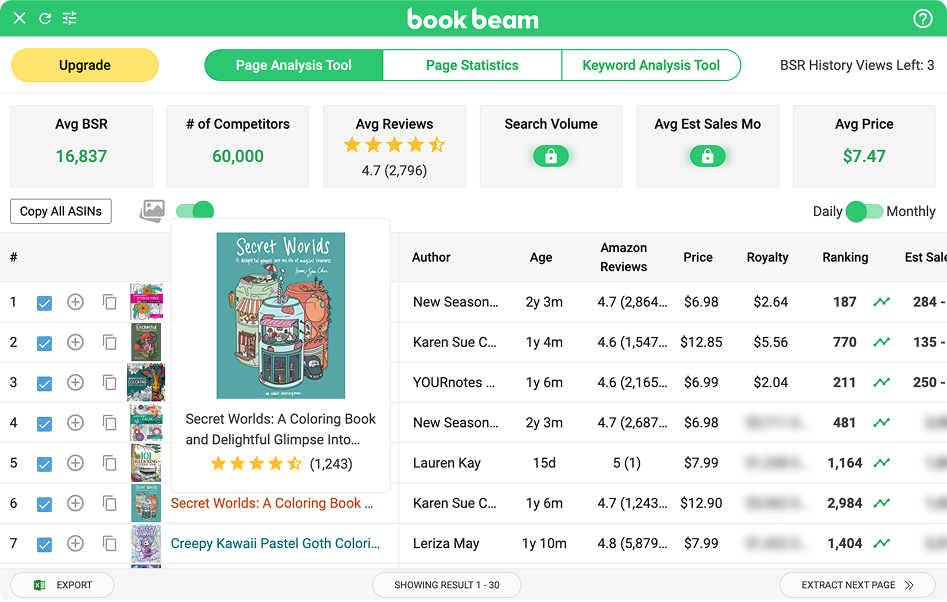
First, BookBeam analyzes the entire landscape of Amazon keywords and surfaces the most effective keyword opportunities for your genre. Forget the guesswork, BookBeam’s keyword research tools let you quickly see the exact search terms real buyers are actually using. By reviewing keyword rankings, search volume, and competition data, you’ll find out precisely which keywords are under-served by existing books, and which are saturated. This is fundamental to niche validation, ensuring you don’t invest hundreds of hours in a manuscript and product listing only to discover there’s little demand or fierce competition blocking your sales.
The secret isn’t just about finding the most popular search terms; anyone can list the top keywords. It’s about targeting Amazon keywords that match genuine buying intent, have respectable search volume, but aren’t dominated by big publishers. BookBeam’s advanced filters make it simple to pinpoint these hidden gems, phrases that consistently generate sales but fly under the radar for most authors. By tracking keyword rankings and analyzing both backend search terms and front-end listing keywords, you get a granular understanding of what’s actually moving books off the digital shelves.
An effective keyword strategy requires ongoing refinement, and BookBeam streamlines this with competitor tracking and performance dashboards. You can monitor keyword movements over time, spot sudden changes in the search algorithm, and adapt your listings before trends shift. This keeps your Amazon keyword approach sharp, agile, and responsive, not locked in outdated strategies. For KDP publishers who want dependable, long-term sales, using a data-driven platform like BookBeam turns keyword research from a guessing game into a reliable growth engine.
If you’re ready to transform your publishing efforts, let BookBeam guide your keyword decisions. Start by identifying profitable keywords today and discover how targeted optimization can make your work truly visible and result in sustained Amazon sales. Don’t just learn keywords, master them, track them, and leverage them for real, lasting publishing success.
Demystifying Keyword Rankings on Amazon
Mastering keyword rankings is foundational for every Amazon KDP publisher determined to stand out and drive sales. From the moment a reader enters search terms to the second your book appears among top results, Amazon algorithms are tirelessly crunching data, evaluating listings, and weighing results. They don’t simply look at keywords in isolation, each word, phrase, and customer action feeds into how your product climbs or falls in the rankings. To unlock the full potential of your publishing business, it’s crucial to understand not just what keywords drive traffic, but how to measure and analyze progress with real data. Let’s look at how you can embrace data-driven tracking to steadily improve your Amazon performance and achieve concrete results.
Tracking and Evaluating Your Book’s Progress Using Data
Success on Amazon isn’t accidental, it’s the result of careful tracking, strategic keyword use, and sharp evaluation of every move you make. Amazon’s ranking algorithm is similar to other digital marketplaces, but what truly sets it apart is the feedback loop created by real customer searches and purchases. Every keyword you choose for your listings, every market-driven tweak, and every collected review feeds fresh data into the engine that powers your book’s keyword rankings. To thrive, you need more than intuition; you need actionable insights and reliable analytics guiding your journey from idea validation to bestseller status.
Here’s where analytics tools come into play. By tapping into platforms like BookBeam, you can constantly monitor your book’s position within search results for your targeted search terms. This means tracking keyword rankings over time , not just once, but as a continual pulse-check on your strategy. The goal is to see how adjustments to your listings, such as swapping out underperforming keywords, adding new search terms, or refining your product description, directly affect visibility and sales. Don’t treat your keywords as ‘set-and-forget’; they should evolve with changing search behavior and data patterns. Track how your products respond to algorithm updates, shifts in customer demand, and new bestseller trends. Are your rankings climbing after optimizing your marketing approach? Are you converting more customer searches into actual sales or reviews?
Tracking your analytics should be an ongoing habit, not just a sporadic activity. Start with a weekly review of your top keyword rankings, sales data, and the correlation between reviews and listing performance. Look for trends in the data: Are certain keywords consistently driving sales, or is there sudden movement after a marketing push? This hands-on tracking enables you to pinpoint which content decisions yield results and which should be reevaluated. Ultimately, consistent evaluation based on data ensures that every tweak and listing update is rooted in real market feedback – not just wishful thinking.
Staying results-focused with your keyword rankings is what separates casual self publishers from those building a sustainable, profitable business. Let data be your guide, observe, adapt, and iterate. With BookBeam, you’ve got a powerful partner to handle the heavy analytics, so you’re always ready to act on the latest data and maximize every marketing and publishing opportunity on Amazon. If you’re ready to find your next breakthrough niche or fine-tune your existing products, let intelligent tracking and data-backed evaluation lead you toward measurable progress and real-world results.
Cracking the Amazon Search Algorithm for KDP Books
Want to truly maximize your book’s discoverability and sales potential on Amazon? Let’s break down exactly how Amazon’s search algorithm operates, and more importantly, how you can work with it, not against it, to get your KDP books found by the right audience. Amazon’s search engine uses a blend of advanced data science and real-time user behavior to connect customer queries with the books most likely to satisfy their needs. Each time a reader enters search terms, Amazon rapidly analyzes millions of possible results, filtering them according to search relevance, keyword alignment, engagement history, and sales performance. The system isn’t just chasing random keywords; it’s weighing a complex mix of factors designed to serve customers the best possible match for their search queries.
To win in this algorithm-driven environment, you need a keyword strategy that’s both targeted and responsive. Think about it: Amazon isn’t just looking at one keyword in isolation. It’s analyzing all of the keywords and keyword phrases present in your backend fields, title, subtitle, and product description, then comparing those terms to real-time queries. The algorithm checks every detail for relevance before deciding where your book ranks in the search results. Mistakenly stuffing your listing with unrelated terms or using too broad keywords can actually hurt your sales and traffic, as Amazon uses engagement metrics and historical results to reward listings that win over real readers. A strong keyword strategy is about aligning your content with buyer intent, not just cramming in as many terms as possible.
BookBeam, an all-in-one market analytics platform, makes this process straightforward. It helps you uncover which keywords actually drive results, track your rankings in Amazon search over time, and adjust your listings to reflect shifts in demand or search algorithm updates. By focusing on search relevance and closely monitoring results, you can fine-tune your strategy to generate consistent traffic and sales. Rather than guessing which queries or keywords work, use tools to validate your approach, spot hidden opportunities, and adapt your listings for maximum reach. Remember, Amazon’s search engine uses the feedback from every click, sale, and review to continually refine who sees your book and when. Get ahead by making data-backed tweaks and always keeping your keyword, strategy, and analytics cycle dynamic. Ready to level up your results? Start analyzing your keywords with BookBeam and turn Amazon’s algorithm into your publishing partner.
Optimizing Your Listings for Amazon Search: Best Practices
Standing out in the competitive Amazon marketplace isn’t about luck; it’s rooted in strategic optimization of your listings. Every decision you make, from keyword choice to product title structure, impacts how the search algorithm positions your book in results. This process goes far beyond just finding popular keywords, it’s about weaving the right keywords into your listings’ metadata, descriptions, and backend fields, ensuring real visibility and relevance. To boost your listing’s discoverability, you’ll need a focused, data-driven approach anchored in search relevance, engagement, and continual refinement of your SEO strategies. Let’s explore proven, actionable methods to elevate your listing’s keyword performance and maximize your reach.
Practical Strategies for Boosting Your Keyword Performance
To secure a prime spot in Amazon search results, you must dive deep into how each element in your listings influences the search algorithm. Start by examining the fundamentals, selecting high-impact keywords that not only fit your book but also map directly to actual buyer intent. Successful listings consistently optimize both visible elements, such as titles, subtitles, and bullet points, and hidden backend keyword fields. When these listings are packed with targeted keywords organically, without sounding forced or robotic, you’ll establish stronger relevance signals to Amazon’s search engine and tap into a much larger audience.
Your priority should be to use keyword research tools and analytics, like BookBeam, to systematically identify what real readers are searching for. Don’t just guess; dig into data to see which keywords are driving conversion. Manually reviewing competitor listings reveals trends in keyword usage, product descriptions, and keyword density. By consistently tracking the keyword rankings of your own listings and those of successful competitors, you’ll be able to spot gaps or new trends, then adjust your SEO tactics accordingly.
One proven practice is to focus on depth as well as breadth in keyword selection. Instead of using only generic keywords, layer in long-tail keyword phrases that describe your listing in more detail, think “mindfulness journal for busy moms” instead of just “journal.” This strategy improves listings’ chances of ranking higher for specific, less competitive searches, often resulting in a boost in sales and lower ad spend. Maximize the overall effectiveness of listings by carefully weaving your target keywords into the book description, making sure each listing’s metadata mirrors popular search queries. Don’t forget backend keywords, these hidden fields play a pivotal role in the search algorithm, so use them to echo relevant keywords not already included elsewhere in your listings.
Adaptation and ongoing refinement are the hallmarks of a top-performing listing. Monitor analytics weekly to see how changes affect performance and search rankings. Use heatmaps or A/B testing for listings to find out which wording or keyword combinations truly capture attention and conversions. Feedback from real buyers, through reviews and Q&A, can uncover fresh keywords you haven’t considered and reveal ways to further refine your listings and keyword strategies. Remember, Amazon’s search algorithm is always evolving, and your keyword approach must evolve with it.
If maximizing discoverability and boosting keyword performance genuinely matter to you, never underestimate the value of rigorous, iterative practice. Strong listings don’t happen by accident, they’re built on a foundation of powerful keywords, smart analytics, and constant learning. Keep upskilling your approach, leverage every keyword, adapt to shifts in search behavior, and make every listing a new opportunity for success. BookBeam makes this entire workflow faster and more actionable, letting you track, compare, and upgrade your keyword SEO across all listings, so you can focus on strategies that drive sustainable Amazon KDP growth.
Leveraging BookBeam to Analyze Amazon Algorithms
To truly master Amazon’s dynamic ecosystem, self publishers need a reliable way to decode how amazon algorithms use keywords, rank products, and interpret data from real-world sales. BookBeam stands out as an indispensable analytics solution designed to bridge the gap between guesswork and actionable insight. Its power lies in surfacing the way amazon’s algorithm is heavily focused on search relevance, sales signals, and keyword rankings, using data-driven methodologies that enable you to make smarter marketing moves without months of trial and error.
Harnessing BookBeam gives you eyes inside the black box of Amazon’s learning algorithms. It taps into a deep well of analytics to spotlight which keywords push books up in search results, which backend search terms the algorithm is prioritizing, and how your listings correlate with customer traffic, reviews, and sustained sales performance. By tracking your products over time, BookBeam reveals essential patterns: How keyword changes affect search visibility, how machine learning interprets new phrases, and which listings gain momentum after targeted optimization.
One of BookBeam’s biggest strengths is evaluation. You’re not left speculating on which keywords might work, every data point is analyzed, making it easy to see which listings and search terms consistently drive results. This lets you fine-tune your backend search terms, target your marketing more effectively, and monitor competitor moves with precision. BookBeam syncs with the pulse of Amazon’s algorithmic updates, reporting how changes in algorithms can suddenly shift rankings or traffic across niche products, so you can adapt rapidly. If search relevance or reviews start moving the needle, you see it in real time, empowering you to act before the crowd.
For publishers seeking sustainable growth instead of fleeting spikes, leveraging BookBeam means riding the wave of continuous optimization. Powerful analytics let you evaluate what’s really affecting your listings, are you missing high-impact keywords, or is it time for a content refresh? With built-in tracking, machine learning insights, and granular sales data, you’ll never be guessing where your efforts are best spent. If you’re serious about turning Amazon’s sophisticated learning algorithms to your advantage, start using BookBeam today. Discover the exact keywords, listings, and strategies delivering results, and accelerate your journey toward a reliable, growing publishing income.
Actionable Checklist: Elevate Your Amazon Keyword Strategy
Ready to transform your approach and maximize the impact of every keyword on Amazon? Here’s an actionable checklist, built on proven fundamentals and tailored to empower KDP publishers who want smarter, data-driven results, not just guesswork. Developing a winning keyword strategy means understanding that Amazon’s algorithm isn’t just ingesting terms; it’s continually analyzing your listings, engagement, sales, and reviews with remarkable precision. Each keyword and term you use plays a distinct role in weaving your books into the fabric of product discovery and visibility on Amazon.
- Audit Your Existing Keywords and Terms. Start by reviewing all keywords in your product listings, titles, subtitles, descriptions, and backend fields. Are your chosen terms genuinely aligned with what readers are actually searching for? Use analytics to spotlight which keywords are attracting clicks versus those that aren’t driving engagement. Eliminate generic, underperforming terms and make room for high-impact keywords rooted in current trends and buying intent.
- Identify Profitable New Keywords Using Analytics. Let real market data, not hunches, fuel your keyword research. Platforms like BookBeam deliver detailed SEO analytics, showing you the search volume, competition level, and performance of Amazon keyword phrases across your niche. Focus on terms that show signs of momentum in products with solid sales and positive reviews, balancing relevance with the right level of competition.
- Optimize Listing Structure for Maximum Impact. Integrate your best keywords naturally across all relevant fields. Avoid stuffing listings with redundant terms; instead, weave long-tail keywords and variants that better match specific buyer queries. Remember, Amazon rewards listings that combine relevance, engagement, and seamless user experience in every product detail.
- Track, Analyze, and Refine Continuously. Mastering Amazon’s algorithm requires ongoing assessment of your keyword strategy. Use BookBeam’s analytics to monitor keyword rankings, sales, and the relationship between engagement and each keyword’s performance. Anchor your marketing and product tweaks in real data, track which changes drive results and where new opportunities appear as competition or demand shifts. Elevate your listings by adapting quickly, not just once a quarter but as an agile, continuous practice.
- Leverage Engagement and Reviews to Uncover Fresh Keywords. Analyze the language real customers use in reviews and questions about your products, then add these new terms to your research pipeline. Amazon’s algorithm values user-driven engagement, so synchronizing your marketing and keyword choices with actual reader feedback makes your listings even more relevant and discoverable.
No one succeeds on Amazon by accident, the strongest publishers thrive by treating their keyword and SEO strategy as a living process, fused with data-driven insight and continual optimization. Use this checklist as your blueprint: audit actively, research smarter, optimize listings, and let analytics guide every decision. Ready to move beyond guesswork? Unlock the full capabilities of Amazon’s algorithm (and your publishing business) today, try BookBeam and make your keyword strategy your most valuable publishing asset.
Mastering Amazon’s algorithm starts with understanding keywords, not just as search terms, but as strategic tools for discoverability and sales. By researching, analyzing, and optimizing your keywords, you unlock greater visibility and competitive advantage in the Kindle marketplace. Remember, every keyword plays a role in how your book is surfaced and ranked. If you want to shortcut the learning curve and get actionable keyword insights instantly, try BookBeam’s market research toolkit. Take control of your publishing journey and let smart keyword strategy work for you, start making data-driven decisions today.