Unlocking the full potential of your book on Amazon starts with a compelling description that does more than summarize, it sells. Whether you’re a first-time author or a seasoned KDP publisher, mastering the art of persuasive book descriptions transforms browsers into buyers. This guide breaks down actionable steps and proven techniques to help your title stand out, build curiosity, and drive real sales. Learn how to craft Amazon book descriptions that are clear, engaging, and optimized for conversion, so your publishing journey becomes more profitable and your stories reach the readers who need them most.
Key Highlights
- Compelling Amazon book descriptions convert browsers into buyers and are essential for KDP publishing success.
- Understanding buyer psychology and using data drives higher-performing, persuasive book descriptions.
- Powerful, attention-grabbing headlines, crafted through market research, dramatically increase reader engagement and conversion rates.
- Strategic formatting and keyword optimization enhance discoverability, readability, and Amazon ranking for your book page.
- BookBeam streamlines keyword research, analytics, and competitor tracking, empowering authors to make data-driven decisions for sales growth.
Why a Compelling Book Description Is Crucial for Amazon KDP Success
The book description is a game-changer for every author aiming for Amazon KDP success. The right book description helps you stand out in Amazon’s vast marketplace, converting browsers into buyers and boosting your conversion rate. Many authors underestimate its impact, focusing solely on book content or cover design. Yet, a well-crafted description acts like your most persuasive salesperson. By understanding buyer psychology and using available data, authors learn what language resonates with readers and how to construct descriptions that spark curiosity, drive action, and position their books strongly against competition. The next step is mastering the core principles behind compelling descriptions for real publishing results.
Understanding Buyer Psychology and the Role of Data in Crafting Effective Descriptions
Crafting an exceptional book description on Amazon isn’t just about fancy writing or listing plot points. It’s about using proven fundamentals, like buyer psychology and actionable data, to write descriptions that truly sell your book. To see meaningful results as an Amazon author, you’ve got to learn what actually moves readers from “maybe” to “must-buy.” Most authors spend days, weeks, and months immersed in writing the book, but only minutes drafting their book description. In reality, the description is your closing pitch, and on Amazon, it’s one of the few touchpoints that directly drives your conversion rate.
Let’s start with buyer psychology. When a customer lands on your Amazon page, they’re bombarded with choices, attention spans are short, and decisions are mostly emotional. What grabs a reader immediately? Compelling book descriptions are rooted in understanding the fears, hopes, and desires of your specific audience. If you’re an author writing for self-help readers, focus your description language on outcomes and personal transformation. If your book is a thriller, highlight suspense and adrenaline. This connection is only possible if you genuinely learn about your target audience and address their problems or aspirations head-on. Always write with the buyer’s mindset at the center. Ask yourself: if you were scrolling through Amazon, what book description would pull you in enough to click “buy now”?
Data backs this up. The most successful authors take a data-driven approach in writing book descriptions. On Amazon, you have access to real-time metrics: conversion rate, bestseller rankings, and customer behavior all reflect whether your description is doing its job. With the right analytics, you can learn exactly which phrasing and book elements convert at higher rates. BookBeam, for example, provides Amazon KDP publishers with deep-dive analytics, revealing what types of book descriptions perform best in specific genres. Use these insights instead of guesswork. Don’t just copy another author’s description format and hope for the best. Analyze their top-performing books, look for patterns in their language, structure, and calls-to-action, and adapt what works for your unique voice and content.
Effective book descriptions utilize both emotional hooks and factual selling points. Begin with a gripping first line that makes readers want to learn more. Address pain points and appeal to a reader’s sense of possibility, “Imagine if you could finally…” or “Are you tired of struggling with…?” This messaging must be validated by your own research. Dive into Amazon reviews for competing books in your niche. Learn the words readers use when describing what they loved or what disappointed them. Feed these insights directly into your description, using their language to resonate more deeply.
Remember, data isn’t just about numbers, it’s about trends and patterns. If your conversion rate spikes after adjusting part of your book description, that’s direct feedback from the market. Never settle for assumptions. Run split tests using Amazon’s tools or adjust your book description length, structure, and value proposition to see what works. BookBeam and similar analytics tools track performance changes over time, giving you confidence in your marketing decisions.
Another core fundamental: relevance and clarity. Book descriptions that perform well always communicate clear value in a concise, engaging way. Don’t overwhelm readers with plot summaries or technical jargon. Focus your book description on why your book matters, what outcome, transformation, or escape does your story provide that others on Amazon do not? Be relentless in your editing, trimming anything that doesn’t directly move readers closer to purchase.
When crafting your next book description, align every sentence with real-world data and marketing psychology. This isn’t about “tricking” the Amazon algorithm or stuffing keywords for the sake of it. Real results come from balancing SEO fundamentals, using keywords organically within your book description, while writing naturally and authentically for the reader. Readers can spot a forced pitch or keyword-stuffed book description a mile away. Your aim is to learn the words Amazon’s audience is actually searching for and integrate those smoothly into a persuasive, benefit-focused narrative.
Let’s touch on the importance of calls to action. Your book description should end by inviting the reader to take the next logical step, whether it’s discovering what happens next, learning a critical new skill, or beginning their transformation journey. Compelling CTAs, when validated with data, can significantly raise your Amazon conversion rate. For example, ending with “Scroll up and click Buy Now to dive into an unforgettable journey” has been shown to boost action for fiction books, while “Unlock proven strategies to change your life, grab your copy today” appeals to non-fiction audiences hungry for results.
For the author committed to sustained Amazon KDP success, your book description isn’t a throwaway. It’s a strategic asset, one you revisit and refine as you learn more about your market, analyze sales data, and build your brand. The true test is not how well your book description reads in isolation, but how much it contributes to your conversion rate, sales, and reviews compared to other books on Amazon in your genre. Leverage every tool available, from analytics platforms like BookBeam to hands-on review mining and direct reader feedback. Make data-driven tweaks often, and be disciplined in your approach. Every lesson learned, every word optimized, moves you closer to a book description that doesn’t just describe, it sells.
At the end of the day, creating a high-converting book description is about combining empathy (understanding the buyer), insight (mining the data), and discipline (testing and refining). Authors who approach their book marketing with this foundational mindset see real, tangible results, not just in book sales, but in a stronger, more responsive audience on Amazon and beyond. If you’re serious about achieving consistent, sustainable success as a self-publishing author, never overlook the importance of your book description, and always let data and buyer psychology guide your writing choices. Now, as you prepare to tackle attention-grabbing headlines, remember that a strong book description, rooted in strategy, makes every other step in the Amazon sales process easier and far more effective.
Start With an Attention-Grabbing Headline: Hook Your Ideal Reader Instantly
Your book page on Amazon must work hard in seconds to hook a potential reader. An attention-grabbing headline at the start of your description is the single fastest way to focus the right audience and get them to read the rest of your page. This is where first impressions are formed and where an author’s only chance to stand out from the sea of competing books lies. Powerful headlines do more than draw the eye, they instantly communicate genre, tone, and reader benefit. By strategically researching what hooks your target market, you’ll transform lukewarm browsers into buyers primed to click “Buy Now.” Let’s break down how smart authors craft headlines that sell by learning from winning market research and real book sales data.
Analyzing High-Converting Book Descriptions Using Market Research Tools
If there’s one truth that holds across every bestselling Amazon page, it’s that the conversion rate depends hugely on your ability to start with a headline that actually stops readers in their tracks. Most authors simply don’t realize just how critical that first line is. But look closer at the top-performing book pages in your niche, those that consistently rack up book sales, attract rave reviews, and win Amazon ads dollars months after launch. You’ll almost always find headline patterns that resonate with the specific emotions, questions, and aspirations of that audience. So, how do you craft a headline that powers your book description instead of letting it fall flat? The answer lies in analytics, deep market research, and smart data-driven solutions like those provided by BookBeam.
Start by looking at high-converting book pages within your genre. Use a market research tool, not just to swipe language, but to truly analyze which words jump out in the best-selling books’ headlines and first lines of their book descriptions. Are the descriptions packed with urgency, curiosity, a sense of escape, or a promise of transformation? It’s often not about inventing something never seen before; it’s about learning the data-driven fundamentals and modeling what clearly works. With BookBeam’s analytics, for example, you can read and review dozens or hundreds of Amazon pages in a fraction of the time it would take manually. The platform identifies which headline elements correlate with spikes in book sales and stronger conversion rates, letting you reverse-engineer effective formulas quickly.
When reading and analyzing these pages, pay particular attention to how headlines match reader intent. For a thriller, the page might start with a question, “Would you betray your family to save your life?” For a self-help title, authors often begin with a bold promise, “Unlock the productivity hacks proven to double your output in one week.” Each of these attention-grabbing headlines leverages market research, using language Amazon’s browsing customers already respond to. The best headlines are never about being clever for its own sake. They’re about getting a prospective reader to think, “This book is for people exactly like me.”
Now, let’s get practical. Start your market research by reading through the bestseller lists in your subgenre on Amazon. Look for similarities in the way top authors open their book descriptions and how headlines are crafted. Notice the specific verbs and vocabulary that pop up over and over; these are words that audiences have proven they’ll respond to when scanning an Amazon page. Analyze whether headlines create a feeling, do they stoke curiosity, offer a solution, or directly address the pain points your audience feels? BookBeam’s description generator can automate much of this competitive intelligence, delivering examples and analytics-backed suggestions to speed up your workflow. If you’re drawn to a headline, odds are, your ideal reader feels the same.
Equally important is identifying what doesn’t work. Read through descriptions from books with strong covers and promising reviews but poor sales, notice the difference in how their Amazon pages start. Weak headlines are vague, generic, or forgettable. They don’t give a reason to stay, fail to create a sense of urgency, and often miss the mark on tone. Analyzing these missteps helps you avoid repeating them in your own descriptions and gives you more confidence in your chosen direction.
A powerful headline is both an art and a science. The market research tools you use should assist, not replace, your understanding of your audience and what feels natural on your book page. Data gives you patterns, sure, but as an author it’s up to you to inject personality and brand voice into every line you write. Maybe your book is quirky, introspective, or suspenseful: whatever your style, the headline must feel like an authentic promise of what the reader will get if they keep reading your description, and ultimately the book itself.
Here’s a crucial tip for Amazon KDP authors: Focus your market research on the actual “above-the-fold” experience, the portion of your page that appears before a shopper needs to click “read more.” Amazon’s layout means many readers will only see your headline and the first few lines by default. Your headline has to do the heavy lifting to entice shoppers to read the entire description or scroll for reviews. Smart, analytics-powered solutions like BookBeam let you see which types of opening lines get the most “read more” clicks, giving you a quantifiable edge. Small tweaks to phrasing, question use, or tone can lead to significant improvements in how many people explore your full Amazon page.
Don’t forget: Testing is everything. After studying and implementing high-performing headline patterns, use analytics to track their real-world impact on your conversion rate and book sales. Maybe one version of your headline grabs attention, but another drives more Amazon ads ROI or boosts the time readers spend on your book page. BookBeam and similar tools allow you to compare headline variants side by side and follow the data to the smartest solution.
As you apply these insights, keep your workflow simple but systematic:
- Analyze several top-performing book descriptions and headlines.
- Read critically and identify what they have in common, do they all begin with bold statements, emotional hooks, or solution-oriented language?
- Use a description generator or analytics platform to gather and compare headline approaches quickly.
- Test designs on your own book page, then track analytics to decide what “reads right” for your audience.
Let data and real-world market research guide your whole description-writing process. Smart Amazon KDP publishers know it’s about more than just one catchy line, it’s about formulating a headline that aligns perfectly with what your ideal reader is looking for when they land on your Amazon page. Remember that every headline is an opportunity to position your book as the solution, the story, or the experience they’ve been seeking.
So, don’t treat your headline as an afterthought. Start every new book page with a commitment to hook, engage, and convert. Use the proven fundamentals discussed here to guide your efforts. Invest in analytics tools that let you analyze both your own results and those of your competitors. Stand back and view your headline in the wider frame of your Amazon page, does it read right, compel action, and reflect the strengths of your book? If you’re not sure, keep testing, keep learning, and keep refining. This is the foundation of building Amazon pages and book descriptions that don’t just inform, but truly sell, and that’s the most reliable way to grow your book sales and author platform over the long term.
Structuring Your Amazon Book Description: Proven Elements That Drive Sales
Getting your Amazon book description right is crucial for converting browsers into buyers. Beyond a catchy headline, the way you structure your description can dramatically impact visibility, engagement, and ultimately your publishing results. Each element, formatting, flow, placement of keywords, and how you surface vital book attributes, plays a specific role in making your Amazon page a high-performing asset. By focusing on proven strategies and optimizing for both the reader’s psychology and Amazon’s algorithm, you create descriptions that stand out in crowded categories, build trust, and boost sales. Let’s break down the optimal formatting strategies that set you apart.
Optimal Page Formatting for Maximum Visibility and Engagement
Structuring the perfect Amazon book description involves much more than simply typing out a summary or rehashing the content of your book. It’s about orchestrating words, formatting, and visual cues to maximize engagement while simultaneously delivering the critical information that primes readers to buy. On Amazon, where thousands of authors compete for eyeballs, only the most strategically formatted book descriptions consistently drive sales and elevate your publishing game.
First, understand that your book description is an integral component of your Amazon page. It’s not an afterthought or secondary to your cover and title, those visual elements might grab initial attention, but the description has the real task of converting it into action. Optimal formatting starts with clarity and organization. A cluttered, wall-of-text description won’t serve you or your audience. Instead, structure your book description into short, skimmable paragraphs, making excellent use of white space. This improves readability on both desktop and mobile Amazon pages, catering to busy readers who may bounce within seconds if their brain can’t immediately process your offer.
Strategic use of bold and italics can quickly highlight the elements that matter most to your audience: your book’s core promise, unique angle, or the most compelling benefit. Remember, Amazon provides limited formatting options, no images or bullet points by default, so you must work within those constraints. Use capitalization, line breaks, and creative spacing to break up monotony. For instance, a well-placed bold first sentence pulls readers in, while a key quote in italics gives your Amazon page personality and credibility.
Incorporating keywords into your book description isn’t just about SEO, though it’s critical for discoverability on Amazon’s search algorithm. You must integrate keywords naturally within compelling, persuasive copy that appeals to both readers and the platform’s bots. Avoid listing keywords in an obvious or repetitive way; instead, weave them seamlessly into sentences that reinforce your book’s core elements, genre, and target audience needs. This boosts your Amazon ranking, bringing your book page to the front lines of organic search results and category lists, which is a game changer for publishing consistently high sales.
A central component of engagement is the use of storytelling in your description structure. Rather than static, lifeless summaries, craft your description as a mini-journey that guides readers through the book’s hook, the problem it addresses, what transformation or entertainment it delivers, and finally, the clear next action. Every element, from headline to closing call-to-action, should flow logically, addressing readers’ subconscious objections and providing the information they’re actually looking for. Amazon readers are decision-makers; they want to know quickly, “Why should I read YOUR book instead of the hundreds of others I see?” Your description must answer this, using formatting to make it impossible to miss.
Optimized Amazon book descriptions use a proven flow: start with a headline that identifies the genre and hooks the reader; follow with a concise but magnetic overview that pins down the book’s direction; then flesh out what readers will gain, experience, or solve. For fiction, tease the plot or emotional stakes without giving away spoilers. For nonfiction, spotlight the pain points and clear outcomes, emphasizing problem-solving and real-world results. Structure the page so every element invites further reading, building engagement step by step.
Effective descriptions mirror the ideal Amazon page experience, grab attention, nurture curiosity, and drive momentum. Each sub-paragraph within your description should feel like a logical next step, guiding readers through a persuasive journey. This holds true whether you’re publishing your first book or you have a robust author catalog, as Amazon’s algorithm rewards high-engagement descriptions with increased visibility and better placement in search results and recommended lists.
Different genres might call for slight variations in formatting. A thriller might use shorter sentences, punchy questions, and more whitespace, pushing the pace. A literary fiction book description may focus on elegant language, while self-help or business books lean towards bullet-point benefits, testimonials, or social proof quotes, all formatted to stand out on an Amazon page. No matter your genre, prioritize structure and formatting that aligns with your book’s promise and the expectations of your reader base.
Let’s not overlook mobile optimization. The majority of Amazon shoppers now browse and buy books on their phones. This means your description should be front-loaded, the first few lines must pack in the most essential elements since that’s all many readers see before tapping “read more.” Keep sentences and paragraphs tight. Critical information, why the book matters, what makes your story unique, or the solution your nonfiction title provides, should be highlighted above the fold on any Amazon page.
Incorporate calls-to-action in a natural but visible way. The Amazon page format often truncates lengthy descriptions, so ending with a direct instruction like “Scroll up and click Buy Now to start reading instantly” or “Join thousands of readers who’ve transformed their workflow with these proven strategies” caps off your pitch with clarity. Formatting this last piece for emphasis (with spacing, capitalization, or italics) makes it more likely to convert with readers.
A vital part of advanced formatting involves researching Amazon’s bestselling pages within your niche to study the flow, spacing, and visual cues used by top authors. Tools like BookBeam elevate this further, use their analytics to analyze hundreds of descriptions, spot the formatting that correlates with better sales and Amazon ads ROI, and integrate those lessons into your workflow. BookBeam’s description generator can help authors develop high-performing structures in minutes, not months, streamlining a process that would otherwise take endless split testing.
Structuring your book description for both human readers and the Amazon platform is the key to maximizing every book launch and long-term sales performance. Mastering the formatting and order of elements isn’t just about aesthetics; it’s about making data-driven publishing decisions that reliably boost sales and reviews. Remember, your description is competing on every Amazon page, your ability to hold attention and communicate value is what separates thriving authors from those who struggle for visibility.
Finally, always iterate. The optimal structure and formatting for your Amazon book description will evolve as you gather more data, feedback from readers, and insights from analytics platforms. Don’t be afraid to update your description structure after launch. Test new elements, split-test format changes, and refine your calls-to-action. Amazon KDP is a dynamic marketplace, your description should be a living asset, continually optimized for engagement, keywords, and, most of all, driving sales. By following these proven formatting fundamentals, you’ll make your Amazon page work harder, smarter, and ultimately more profitably for your publishing business.
Optimize Your Description With Relevant Keywords to Outrank the Competition
Rising above the crowded Amazon marketplace calls for more than a gripping story or a beautiful book cover, it demands a precise, data-driven publishing approach where every book description is carefully optimized. Effective authors understand that the right keywords woven skillfully into your Amazon book description give you a measurable edge, drastically improving both discoverability and conversion. Mastering keyword optimization isn’t about stuffing words aimlessly; it’s about purposeful writing that works for both readers and the Amazon algorithm. Let’s explore how integrating the right keywords, especially with the help of powerful tools like BookBeam, ensures your book stands out, ranks higher, and connects genuinely with your desired audience.
How BookBeam Streamlines Keyword Research and Improves Discoverability
For Amazon authors intent on growing a sustainable publishing business, discoverability is everything. A fantastic book can languish on page twenty of Amazon’s search results if its description isn’t optimized with the right keywords. Yet for most authors, keyword optimization feels like a confusing, time-consuming guessing game, one that eats into actual writing time and leaves you wondering if the effort will even pay off. This is where BookBeam becomes invaluable, transforming Amazon KDP keyword research from a grind into a strategic, focused process with real-world results.
Let’s start with why keywords matter so much on your Amazon book page. Keywords are how Amazon’s engine connects readers with books they’re already seeking. When a reader punches “productivity hacks for writers” or “cozy winter romance” into Amazon’s search bar, it’s those keywords, embedded in a book’s description, title, and metadata, that determine which books show up and which get buried. Simply hoping Amazon finds your book is a recipe for obscurity. Authors who prioritize keywords ensure their descriptions land their books in front of exactly the readers who’ll buy them.
BookBeam takes the overwhelm out of this entire process. Unlike unreliable guesswork, BookBeam analyzes mountains of Amazon data, revealing the precise keywords real readers are searching for in your book’s niche. Instead of repeating the mistakes of countless authors who stuff descriptions with generic words in the hope of a miracle, you can use BookBeam to quickly identify which keywords carry weight, and which are irrelevant. Imagine finding keywords that not only match your book’s content but actively lead readers from discovery to purchase because they’re proven performers. That’s the power of genuine, data-backed keyword optimization.
Let’s address the pain points head-on. Most book descriptions fail to move the needle on Amazon because authors either overuse broad, untargeted keywords or overlook critical, high-intent phrases readers actually type. BookBeam’s advantage is in its precise, genre-specific data. You’re not left guessing whether “thriller,” “mystery book,” or “crime novel” is the best way to reach your target audience. The platform cross-examines existing bestselling Amazon pages, filters out low-performing search terms, and delivers actionable keyword lists that unlock maximum visibility for your book.
It doesn’t end there. Keyword research is only as powerful as its integration, and this is where BookBeam’s analytics truly shine for the practical-minded author. It doesn’t just hand you a jumble of keywords. It provides insight into where and how to place them naturally within your Amazon book description, headline, and even your author bio. By analyzing which books soar to the top of the Amazon page and which descriptions convince readers to click “Buy Now,” BookBeam helps you mimic best practices without resorting to keyword stuffing. This approach not only appeases Amazon’s algorithm but ensures your writing still reads naturally, resonating with readers instead of repelling them.
Here’s how successful authors leverage BookBeam to optimize their book descriptions and outpace the competition:
- Niche-Specific Keyword Generation: With BookBeam, authors can enter the core subject or theme of their book and immediately receive a curated list of high-impact keywords specific to their genre. For instance, an author publishing a time management book can discover that “productivity for busy parents” or “organizing your life book” are current high-traffic search terms winning clicks from real Amazon shoppers.
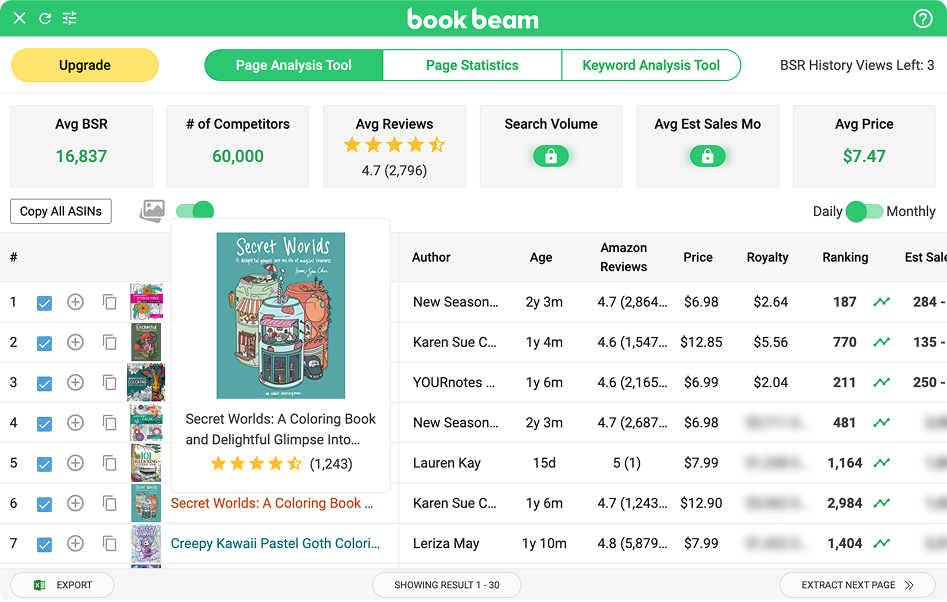
- Competition Analysis: Through BookBeam’s competitor tracking, you can see precisely which keywords top-selling Amazon books in your category use in their descriptions, titles, and backend metadata. This provides an invaluable shortcut to reverse-engineer what’s already working, removing the blindfold and putting you ahead of other authors who rely on trial and error.
- Performance Tracking: Perhaps the most powerful feature for data-driven authors is BookBeam’s ongoing analytics. Once your book description is optimized with relevant keywords, you can track how changes impact your book’s visibility, conversion rate, and sales rank. Does adding “young adult fantasy” or “mindfulness journal” drive more Amazon readers to your book page? BookBeam gives you clarity through real metrics, not gut feelings.
- Description Optimization Guidance: The platform doesn’t leave you alone after providing keywords. BookBeam offers specific, actionable advice for weaving those keywords into engaging, benefit-driven sentences. This helps you create a book description that’s both highly optimized for Amazon’s algorithm and truly appealing to your readers.
But optimization isn’t just about visibility; it’s about connection. Thoughtfully integrating keywords helps your books appear in front of the right Amazon audience, those readers already primed to want what your book offers. The words you use in your book description, thanks to BookBeam’s guidance, directly match the search intent of your ideal reader, making it far more likely that they’ll click, read, and ultimately buy.
Let’s ground this with a practical example. Suppose you’re releasing a historical romance. After plugging your synopsis into BookBeam, you learn that “Victorian love story,” “enemies to lovers romance,” and “clean historical romance book” are hot keywords in your niche, based on what real Amazon readers search for and buy. Instead of a bland or generic description, you can now craft one that highlights these specific themes, such as:
“Step into a sweeping Victorian love story… For fans of clean historical romance books and unforgettable enemies to lovers tales, this novel delivers the adventure and heart you crave.”
Here, you’ve naturally inserted the most powerful, reader-tested keywords while keeping your prose authentic and compelling. The result? Better Amazon rankings, more qualified readers, and increased book sales, without ever sounding forced or robotic.
Remember, Amazon rewards optimization that feels seamless to the end reader. A description overloaded with keywords will trip Amazon’s filters and turn off savvy shoppers. The BookBeam approach is built on finesse: learning which keywords have the right balance of search volume and relevance, then integrating them organically into every book description you write.
Here are some actionable tips for integrating BookBeam’s keyword recommendations effectively:
- Front-Load Your Description: Place your highest priority keywords in the opening lines of your Amazon book description. This serves both readers (who generally read only the first few sentences) and Amazon’s algorithm, which scans for relevance early.
- Vary Keyword Phrasing: Use close variations and related terms. If “urban fantasy book” is key, sprinkle in “urban fantasy series,” “gripping fantasy tale,” and “modern fantasy adventure.”
- Stay Reader-Focused: Every keyword should reinforce the genuine appeal of your book. If your description starts feeling unnatural, tone down the repetition and favor clarity.
- Monitor, Test, and Tweak: Let BookBeam’s analytics guide your iterative approach. Monitor how each book description update impacts page views, sales, and Amazon bestseller ranking. Refine, don’t simply revise blindly.
As you gain confidence and your catalog grows, you’ll notice one thing: keyword-optimized book descriptions aren’t a magic bullet, but they are a force multiplier. Used thoughtfully, with BookBeam’s assistance, keywords help your author brand flourish. You’ll attract more readers, boost the presence of all your books, and approach every Amazon launch with the data-driven discipline that sets high-earning authors apart from the crowd.
If you’re serious about making your Amazon book descriptions not just informative but truly transformative for your publishing business, it’s time to move beyond guesswork. Trust the data. Embrace tools designed for real-world results. Make BookBeam your partner, and unlock the real power of keyword optimization, turning every description into an engine for discoverability, ranking, and ongoing Amazon book sales. Don’t let your next publishing effort get lost in the algorithm noise. Actively optimize, and watch your book, and your author career, reach more readers, faster than ever before.
Enhance Your Book Sales by Leveraging Amazon Ads and Data-Driven Insights
If you want to consistently enhance your book sales and expand your publishing business, you’ve got to do more than write well and craft optimized book descriptions. The real step-change comes when you leverage Amazon ads and data-driven insights that inform every aspect of your marketing decisions. Whether you’re an emerging author or an experienced KDP publisher looking to grow, a smart, analytics-fueled approach is how you differentiate yourself in an intensely competitive market. Using dynamic advertising strategies in combination with deep analytics, you’ll be able to adjust quickly, scale wins, and track precisely what’s fueling your sales, transforming basic marketing into a high-performance engine for your books and author brand.
Learn to Track, Adjust, and Scale Your Book Marketing With Smart Analytics Solutions
The leap from occasional book sales to a consistent, sustainable income on Amazon doesn’t happen by accident, it’s driven by authors and publishers who learn to track, adjust, and scale their book marketing using analytics at every turn. Let’s pull back the curtain on why this matters and how you can implement these fundamentals for real-world results.
First, if you want to enhance your book sales, understand that every marketing move on Amazon, especially when dealing with Amazon ads, should be informed by cold, hard data, not gut feelings or “best guesses.” Many authors still rely on intuition or copied strategies that quickly lose potency as trends shift and niches evolve. What sets top performers apart is an unwavering commitment to learning from the numbers: knowing precisely what version of your description, keyword targeting, or ad creative is pulling readers in and which ones are stalling out.
Tracking starts with the basics, but smart solutions like BookBeam take it much further. You’ll want to watch not only your sales but also ad impressions, click-through rates, page reads, and conversion rates as you experiment with different Amazon ads campaigns. If you’re guessing which keywords or ad copy drives readers from a casual glance to a decisive buy, you’re leaving money on the table. Accurate analytics shine a spotlight on every step of your reader’s journey, from first seeing your book page or ad to reading the description and ultimately clicking “Buy Now.”
Let’s put this into practical terms. Suppose you’ve got two versions of your Amazon book description, one laser-focused on reader pain points, enhanced with proven genre-specific keywords, another more generic and broad. By tracking which version results in higher ad-driven traffic and better conversion rates, you learn exactly how your audience responds. The smart author will read these analytics regularly, tweaking headline copy, adjusting call-to-action phrasing, and refining keywords based on which approaches demonstrably increase book sales.
Next, don’t overlook the power of Amazon ads themselves as both a visibility tool and a laboratory for optimizing your Amazon page. Running a range of campaigns, using Sponsored Products, Lockscreen, or Category Ads, lets you scale what works and experiment with new targeting at a controlled cost. Smart publishers integrate BookBeam’s analytics with their Amazon ads data, gaining granular insight into which ads pull in not just clicks but engaged readers who actually read your description, click “read more,” and follow through to purchase. This is what separates simply getting traffic from driving true sales.
As you adjust, start paying attention to the ripple effects. Did revising your description with new keywords, data-mined using BookBeam, suddenly make one of your ad sets profitable? Did a particular Amazon ads campaign spike your visibility for one book, but plateau for another? The aim isn’t just more ads, but smarter ads. Scale budgets where analytics show a real return, and pull back when results slip. Marketers call this “incremental scaling”, you stretch what’s working bit by bit, always guided by numbers, not guesswork.
Let’s talk about scaling with confidence. Say you’ve improved your keywords, rewritten your book description for clarity and power, and run several rounds of Amazon ads, tracking the results at every stage. Every adjustment, whether it’s testing a new hook in your description, rotating in a fresh call-to-action, or shifting ad copy for a specific audience segment, feeds data back into your overall strategy. Smart solutions like BookBeam automate much of this, giving actionable insights on description effectiveness, suggested ad budget increases, and competitor metrics from the Amazon marketplace. This analytical cycle, track, adjust, scale, repeat, is how authors grow beyond episodic sales toward steady, upward-trending book sales and lasting brand presence.
But it doesn’t stop there. True growth comes when you use analytics to move beyond reactionary changes, proactively predicting what will work next. Are there keywords rising in your niche that you can capitalize on before competitors catch on? Are your Amazon ads revealing hidden reader segments, demographics or interests, from their click and conversion data, which you hadn’t thought to target before? The best authors and marketers learn from every campaign, every line of their book description, and every single ad dollar spent.
Here are some practical, mentor-level action steps any author can implement to maximize their marketing with analytics and Amazon ads:
- Set Clear Metrics for Every Campaign: Don’t settle for vague goals. Instead, track your Amazon ads’ specific outcomes: which keywords yielded the most page reads, which description versions had the best click-through rates, and what conversions resulted from targeted campaigns.
- Continuous A/B Testing: Use analytics to test alternate headlines, book description openings, or calls-to-action. Track which descriptions boost your ad-driven sales, not just vanity metrics like impressions, but hard conversion numbers.
- Feedback Loops From Analytics: Use BookBeam’s smart solutions to analyze top-performing Amazon pages in your genre weekly. Feed this data into your own description changes and ad targets to stay ahead of trends.
- Keyword Expansion and Refinement: Apply analytics to constantly monitor which keywords are losing steam and which generate momentum. Adapt your descriptions and Amazon ads based on these shifts, so you always speak your reader’s language.
- Scale What Works: When a campaign, Amazon ads or book description version, demonstrates a proven ROI, don’t hesitate. Reallocate marketing budget and promo efforts to maximize that win, always tracking for diminishing returns.
A data-driven, analytical approach isn’t just for big publishing companies with deep pockets. Thanks to modern smart solutions, every author now has access to the same level of market intelligence that once powered only the largest players. BookBeam delivers market analysis, competitor insights, and ad performance evaluations in a simple dashboard, empowering you to make professional-grade adjustments with each new campaign.
Data also helps you avoid costly pitfalls. Analytics can highlight which Amazon ads are underperforming, wasting ad spend without supporting your book sales, or which description updates accidentally lower conversion rates. By quickly identifying and correcting these missteps, you minimize risk and protect your publishing ROI.
Remember, every minute spent learning from analytics and tracking Amazon ads is an investment in your book’s long-term sales success. The barrier to entry has never been lower, but the competition has never been fiercer. The difference will always be the author who reads and reacts to what the data shows, adjusting in real-time and scaling the strategies that drive sales.
Are you ready to maximize your workflow and publishing income? Start by tracking every promotional effort, learn what each analytic signal means for your Amazon page, and partner with tools like BookBeam for actionable, smart marketing solutions that take your book sales farther, faster. If you want to build a thriving author business, let data, not guesswork, drive your growth. Embrace analytics, refine your Amazon ads, and scale up as soon as the results prove the time is right. Your next best-selling book isn’t just about the writing, it’s in the numbers you choose to track, adjust, and scale.
Mastering your Amazon book description is more than just ticking a box, it’s your strongest marketing tool on the world’s largest book marketplace. By blending persuasive copy, targeted keywords, and clear calls to action, you position your book for maximum visibility and sales. Use BookBeam to analyze bestselling description trends, test different approaches, and back every word with data-driven insights. Empower your publishing journey with strong, conversion-focused descriptions that captivate readers and turn browsers into buyers. Start refining your descriptions today and watch your book’s performance soar above the competition.